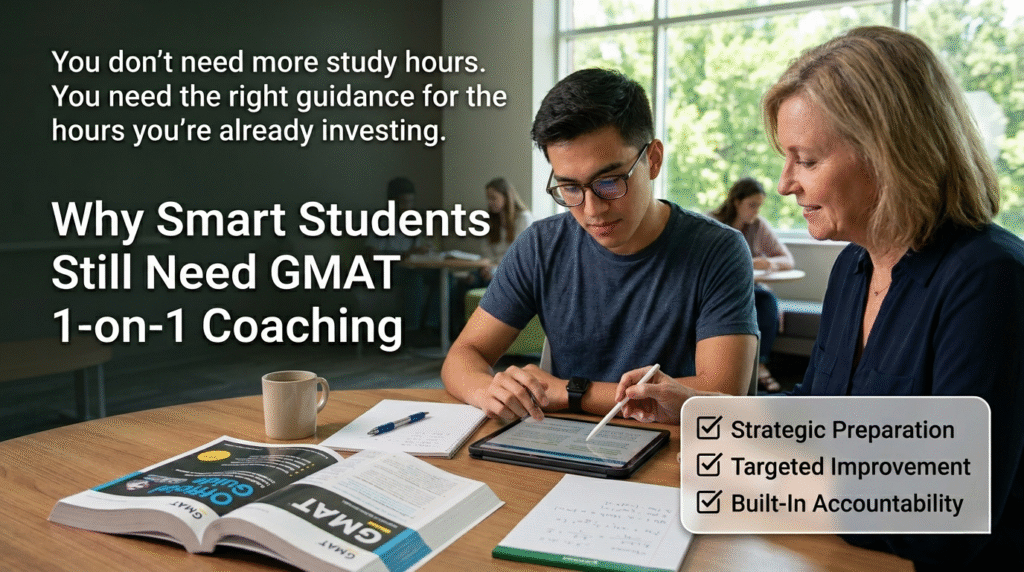
Why Smart Students Still Need GMAT 1-on-1 Coaching
There is a very specific kind of optimism that appears sometime around Day Three of GMAT preparation.
It usually begins with a fresh notebook, a color-coded study plan, and a sentence nobody has ever said calmly: “I’ll just study two hours every evening after work.”
For roughly six days, this feels achievable.
Then life intervenes. Someone has a wedding. Someone else has a quarterly review. The internet suddenly becomes deeply fascinating. You spend forty minutes researching whether fountain pens improve memory retention. And somewhere between algebraic word problems and critical reasoning passages about municipal recycling policies, the GMAT begins to feel less like an exam and more like an elaborate psychological experiment designed by mildly disappointed mathematicians.
This is usually the point where even very smart students discover something slightly uncomfortable: intelligence alone is not always enough.
And that, strangely enough, is why gmat 1 on 1 coaching continues to matter so much.
The GMAT Is Not a Normal Exam
Most exams reward effort in a fairly straightforward way. Study chapters, memorize concepts, reproduce information, survive.
The GMAT does not entirely operate on this system.
The exam is oddly strategic. It measures timing, adaptability, decision-making, mental stamina, and your ability to remain emotionally stable while a geometry question quietly ruins your afternoon.
You can know the content and still struggle.
This is what surprises many students, especially high-achievers. They assume discipline and intelligence should naturally lead to improvement. But GMAT preparation often exposes tiny inefficiencies people never notice on ordinary tests.
Some students spend twenty minutes solving problems that should take two. Others panic during verbal sections despite reading constantly in everyday life. Some become trapped in what can only be described as “productive confusion,” where they study endlessly without actually improving.
This is where gmat private tutoring becomes valuable. Not because students lack capability, but because the exam itself is unusually specific.
It rewards precision more than volume.
Self-Study Sounds Noble Until About Week Four
Self-study has a wonderful reputation because it sounds disciplined and independent. And occasionally it works beautifully.
But most self-study journeys eventually develop certain recognizable symptoms.
You begin watching twelve different YouTube instructors who all explain percentages differently. Your bookmarks multiply uncontrollably. You create increasingly sophisticated study schedules instead of studying. You spend entire evenings convincing yourself that researching the “best GMAT strategy” technically counts as preparation.
And then there is the quiet emotional problem nobody discusses enough: studying alone makes it very difficult to identify your actual weaknesses.
Human beings are surprisingly bad at diagnosing themselves academically. We avoid uncomfortable topics. We repeat familiar question types because they feel productive. We mistake activity for progress.
A good gmat personal tutoring program interrupts this cycle rather effectively.
Not aggressively. Just accurately.
A tutor notices patterns students miss entirely. Maybe your quant concepts are fine, but your timing collapses under pressure. Maybe your verbal accuracy drops only after difficult passages. Maybe you are solving questions correctly but using methods too slow for the actual exam.
These are small details. But the GMAT is practically built out of small details.
Personalized Coaching Changes the Entire Experience
One of the strange comforts of gmat 1 on 1 tutoring is that preparation suddenly becomes less chaotic.
There is a plan.
Not a generic study calendar downloaded from somewhere in the darker corners of Reddit. An actual plan built around your habits, strengths, weaknesses, schedule, and target score.
This changes things psychologically.
Students stop studying “everything” and begin studying what matters.
And oddly enough, this often reduces stress. There is something reassuring about hearing a tutor say, “You do not need to spend another six hours reviewing inequalities. Your real problem is pacing.”
Because now the problem has shape. It becomes manageable.
Good tutors also provide something students rarely realize they need: emotional neutrality.
When you study alone, every mock test becomes dramatic. A bad score feels catastrophic. A good score feels suspiciously accidental. Students spiral. They overreact. They convince themselves they are either geniuses or hopeless, sometimes within the same afternoon.
An experienced tutor has seen this before. Many times.
They know that one difficult mock test does not define your future. They know when to push harder and when to simplify things. They help students remain consistent, which is perhaps the least glamorous but most important part of GMAT success.
Accountability Is More Powerful Than Motivation
Motivation is unreliable.
People imagine high scorers waking up at 5 a.m. full of determination, calmly solving probability questions while birds sing outside the window. In reality, most students are tired professionals trying to study after long workdays while simultaneously wondering if they should just move to a cabin and become a beekeeper instead.
Consistency matters more than motivation ever will.
This is another reason gmat 1 on 1 coaching works so well. Accountability changes behavior. Knowing somebody will review your progress next week subtly forces structure into your schedule.
You procrastinate less.
You take mock tests on time.
You stop endlessly “preparing to prepare.”
And over several months, those small behavioral improvements create surprisingly large score improvements.
The Emotional Side Nobody Talks About
Standardized tests have an odd ability to become personal.
Students start attaching their self-worth to practice scores. A difficult quant section suddenly feels like evidence of intellectual failure. Logical reasoning questions somehow become existential.
It is exhausting.
What makes gmat private tutoring genuinely valuable is not just academic guidance, but perspective. Tutors remind students that struggling is normal. Improvement is rarely linear. Some weeks feel brilliant. Others feel like you have forgotten basic arithmetic entirely.
That inconsistency is part of the process.
And perhaps the most important thing personalized coaching provides is confidence grounded in evidence rather than emotion.
Not false reassurance. Real progress.
Final Thoughts
The funny thing about the GMAT is that it humbles almost everyone eventually.
Not because students are incapable, but because the exam demands a very particular kind of preparation: strategic, disciplined, adaptive, and surprisingly emotional.
Smart students still need help sometimes.
In fact, they often benefit from it the most.
Because gmat personal tutoring is not about intelligence. It is about efficiency. Clarity. Direction. Having someone who can see the patterns you cannot.
And in a test famous for making capable people question their sanity over algebraic train problems, that guidance can make all the difference.
FAQs
1. What are the benefits of GMAT 1-on-1 tutoring?
GMAT 1-on-1 tutoring provides personalized study plans, targeted feedback, flexible pacing, and strategies tailored to your strengths and weaknesses.
2. Is GMAT private tutoring better than self-study?
For many students, yes. Private tutoring helps identify hidden weaknesses, improves accountability, and creates a more efficient preparation strategy.
3. How long should I take GMAT 1-on-1 coaching?
It depends on your target score and current level, but most students benefit from 2–6 months of structured coaching.
4. Who should consider GMAT personal tutoring?
Working professionals, students aiming for high scores, repeat test takers, and anyone struggling with consistency or timing can benefit greatly from personalized coaching.