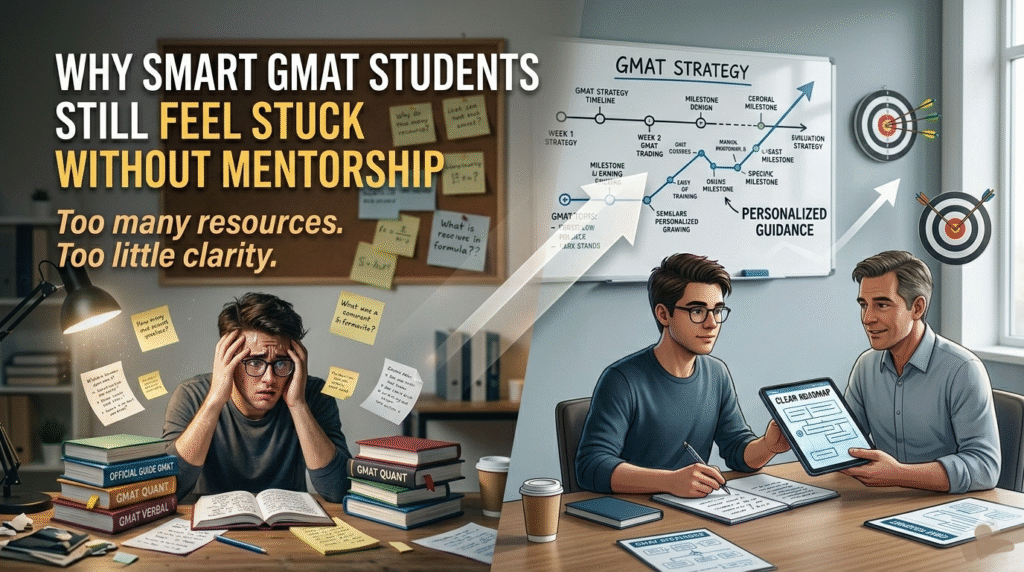
Why Smart GMAT Students Still Get Stuck Without Personalized Mentorship
There is a very specific kind of confidence that appears around Week Two of GMAT preparation.
It usually arrives after someone watches three YouTube strategy videos, purchases a suspiciously expensive set of highlighters, and scores moderately well on a single Quant practice set at 1:14 a.m.
At this stage, many students begin behaving like retired military strategists. Spreadsheets emerge. Color-coded study calendars appear. One folder is named “GMAT FINAL FINAL REAL.” Another is called “NEW ACTUAL FINAL.”
Naturally, very little studying happens.
This is not because MBA aspirants are lazy. Quite the opposite. Most serious GMAT students are hardworking people attempting to solve an unusually strange exam while simultaneously managing jobs, deadlines, existential panic, and occasionally a social life that now consists primarily of saying, “Sorry, I can’t. I have Data Insights.”
And this is precisely where personalized mentorship changes everything.
Not because students suddenly become more intelligent. But because someone finally helps them stop preparing incorrectly.
The Curious Problem With Modern GMAT Preparation
The internet has done something remarkable to education.
It has made information infinitely available while somehow making students infinitely more confused.
A student preparing for the GMAT today can access:
- 47 different study plans
- 12 conflicting Quant strategies
- Reddit threads written by people who claim they studied for six days and scored 785
- Productivity systems involving timers, flashcards, dopamine regulation, and what appears to be military-grade sleep optimization
After about three hours online, many students know less than when they started.
One of the quieter benefits of GMAT 1 on 1 Coaching is that it reduces noise. A good mentor does not simply teach arithmetic or grammar. They act more like an experienced guide walking someone through a crowded airport where every sign points in a different direction.
And the GMAT, unfortunately, is full of misleading signs.
Why Generic Preparation Often Fails Serious Students
Most students assume the problem is “content weakness.”
Occasionally it is.
But far more often, the issue is behavioral.
A student may understand probability perfectly well and still lose points because they panic after one difficult question and begin speed-solving like a contestant in a game show involving electrical hazards.
Others develop elaborate routines that look productive but are mostly decorative.
There are students who spend forty minutes reorganizing bookmarks for verbal resources. Students who create five-hour study plans despite never having successfully completed a two-hour one. Students who genuinely believe watching a motivational reel with cinematic background music counts as preparation.
This is where GMAT Private Tutoring becomes remarkably effective.
A skilled mentor notices patterns students cannot see themselves.
For example:
Some students are over-studying the wrong topics
They spend weeks mastering difficult geometry concepts that barely appear while ignoring critical reasoning weaknesses quietly destroying their score.
Some students mistake familiarity for mastery
Reading explanations feels productive. Solving independently feels terrifying. Unfortunately, the exam prefers the second one.
Some students are trapped in “resource hopping”
They keep switching books, courses, and teachers every six days as though the perfect PDF somewhere on the internet will suddenly unlock a 755.
Usually it does not.
Usually it just creates seventeen open tabs and emotional fatigue.
The Hidden Advantage of a Personal Tutor for GMAT
There is something oddly reassuring about having one person who understands your preparation deeply.
Not theoretically.
Specifically.
A good personal tutor for GMAT knows:
- which question types trigger careless errors
- when confidence drops during mocks
- whether timing issues are real or anxiety-driven
- which habits are helping
- which habits are simply elaborate procrastination wearing spectacles
This level of personalization matters because the GMAT is not a school exam. It is not testing whether you memorized chapters responsibly like a diligent teenager.
It tests decision-making under pressure.
And pressure makes people strange.
Perfectly rational adults suddenly convince themselves that changing notebook brands will improve Verbal accuracy. One decent mock score creates dangerous overconfidence. One bad mock creates dramatic career reassessments involving goat farming in the mountains.
The emotional swings are astonishing.
The best mentors understand this without dramatizing it.
What Actually Makes the Best GMAT Private Tutors Different?
The phrase “expert mentor” gets thrown around online with impressive recklessness.
But the best GMAT private tutors usually share a few surprisingly practical traits.
They diagnose before they teach
Weaknesses are rarely what students think they are.
Someone struggling in Quant may actually have timing problems. Someone failing Verbal may simply be rushing comprehension passages because they fear running out of time.
Strong tutors investigate patterns instead of prescribing generic solutions.
They simplify preparation
Many students already possess enough resources to score well.
What they lack is structure.
The right mentor reduces unnecessary material, prioritizes high-impact work, and prevents preparation from becoming an archaeological excavation of random PDFs.
They adapt to the student
Some students need accountability.
Others need confidence rebuilding.
Some require aggressive strategy correction. Others simply need someone to say, calmly and without theatrical intensity, “You do not need to solve 400 questions tonight.”
Good mentorship is responsive, not robotic.
The Strange Psychology of Studying Alone
There is an oddly theatrical loneliness to GMAT preparation.
At some point, almost every student finds themselves sitting in front of a laptop at midnight eating questionable snacks while staring at a sentence correction explanation written in language clearly designed to intimidate civilians.
Studying alone often creates distorted thinking.
Without feedback, students can spend weeks reinforcing inefficient habits. They begin believing:
- more hours automatically mean better preparation
- difficult questions should always be solved quickly
- one terrible mock defines their future
- everyone online is somehow scoring higher with less effort
None of this is especially true.
Working with a mentor introduces perspective. And perspective, during GMAT prep, is surprisingly valuable.
This is one reason many ambitious applicants eventually move toward top gmat coaching programs that include personalized guidance instead of purely recorded content.
Because eventually students realize the issue is no longer access to information.
It is interpretation.
Why Serious Aspirants Eventually Choose Personalized Coaching
There comes a point in preparation where students stop asking:
“What resource should I buy?”
And start asking:
“Why am I still stuck despite doing everything?”
That question changes the entire preparation process.
The answer is often not effort. Most serious MBA aspirants are already working hard enough to concern nearby family members.
The real breakthrough usually comes from precision.
Knowing:
- what to ignore
- what to improve first
- how to review mistakes properly
- when strategy matters more than theory
- when burnout is quietly reducing performance
This is why GMAT 1 on 1 Coaching continues to grow despite endless free material online.
Because guidance shortens confusion.
And confusion, more than difficulty, is what exhausts most students.
The Final Reality About GMAT Success
The GMAT has a peculiar way of humbling intelligent people.
That is partly why business schools like it.
The exam rewards consistency more than dramatic bursts of motivation. It rewards self-awareness more than ego. And it quietly punishes chaotic preparation disguised as ambition.
Students often begin preparation believing success depends on finding the perfect trick.
Eventually, most discover something less exciting but far more useful:
steady improvement,
clear feedback,
intentional practice.